Research atlas for early Christianity. Claims are tagged attested, traditional, or disputed. Copyrighted full texts, including CCEL editions, are not included.
Disputed. Works and dates attested; his exact base is DISPUTED (Mar Mattai link is late).
Stand-in
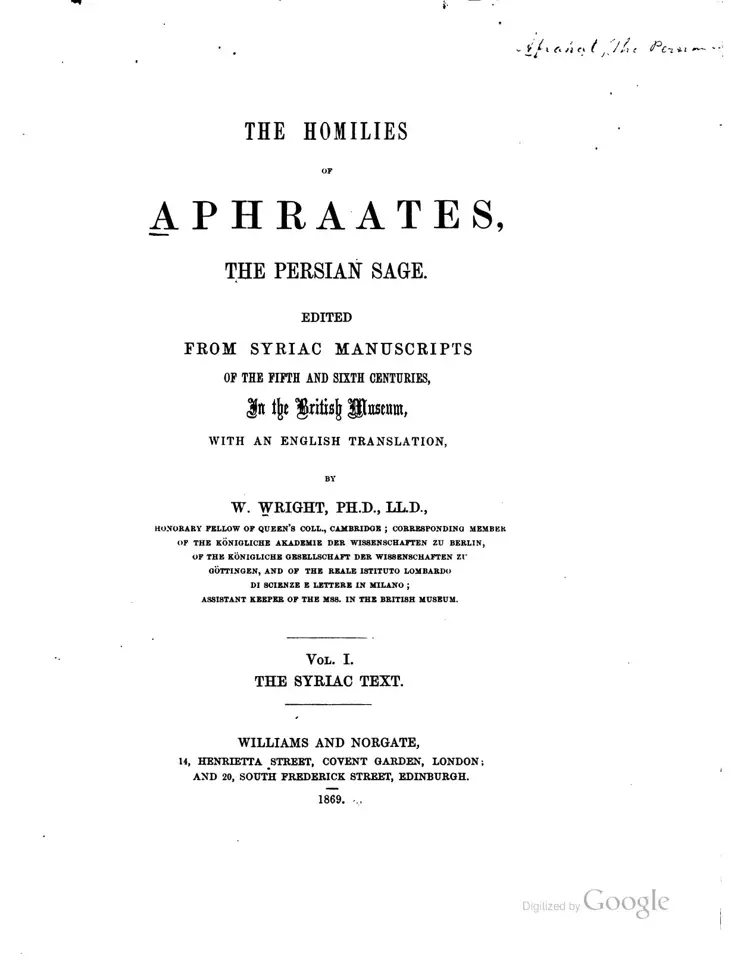
HONEST STAND-IN. No contemporary portrait of Aphrahat exists. Title page of W. Wright, The Homilies of Aphraates, the Persian Sage, vol. I: The Syriac Text (London: Williams and Norgate, 1869), edited from 5th- and 6th-century British Museum Syriac manuscripts (including BL Add. 17182, dated portions 474 and 512). Image is a page from the Google-digitized public-domain scan on Internet Archive (homiliesaphraat00wriggoog); the small 'Digitized by Google' mark is left in place. A later 1886 engraving captioned 'St Aphraate' (Wikidata P18) was not used: it may depict Aphraates the Antioch hermit rather than the Persian Sage, and it is an imaginary Western hagiographic scene.Title page of W. Wright (ed.), The Homilies of Aphraates, the Persian Sage (London: Williams and Norgate, 1869). Public domain. Digitized copy via Internet Archive / Google Books (identifier homiliesaphraat00wriggoog). Public domain (1869 publication); scan marked NOT_IN_COPYRIGHT on Internet ArchiveSource page
Earliest Syriac church writer whose works survive. His 23 Demonstrations, written in the Persian Empire during Shapur II's persecution, show a Semitic Christianity little touched by Greek philosophy.
Bases
Loading the map…
Monastery of Mar Mattai · later tradition links him to the region of Mosul (Mar Mattai) · disputed
Persia (region) · Persian Empire (attested) · 337-345 · attested
Places
Councils
No council in this list names them as a participant.