Research atlas for early Christianity. Claims are tagged attested, traditional, or disputed. Copyrighted full texts, including CCEL editions, are not included.
attested. Attested in Syriac sources. The exact site on the Euphrates is uncertain; coordinates are approximate.
Stand-in
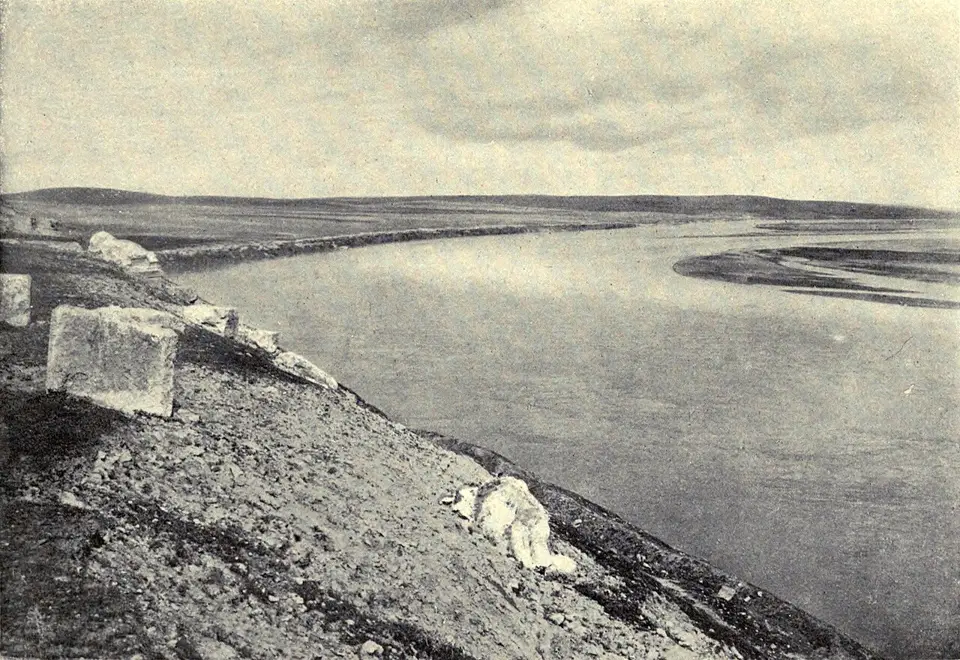
HONEST STAND-IN, not a photograph of the monastery. View of the Euphrates from the mound of Carchemish (west bank), published 1910. Yaqut places Qenneshre on the east bank of the Euphrates facing Jirbas (Europos / modern Jarablus). Yousef al-Dabte's 2005-06 excavation on that east bank is the identification now preferred (Tannous, GEDSH; Wikipedia). The Spanish 1990s candidate near the Sajur confluence is less likely. Do not use photos of Qinnasrin/Chalcis (a different place) or of Qal'at Najm (a different fortress). No excavation photograph of al-Dabte's site was found on Commons this turn.David George Hogarth, Accidents of an Antiquary's Life (1910), 'Euphrates from The Mound of Carchemish.' Public domain. Wikimedia Commons; original scan at Internet Archive (accidentsofantiq00hogarich). Public domainSource page
Founded on the Euphrates around 530 by monks expelled from near Antioch, Qenneshre became the leading centre of Greek learning in the Syriac Orthodox church. Severus Sebokht wrote on astronomy there and mentions the Indian numerals.
Place: Qenneshre (Euphrates; site not securely located) (same site as hb-qenneshre) · On the map
People
John bar Aphtonia (founder, c. 530)
Severus Sebokht (d. 667)
Athanasius of Balad
Jacob of Edessa (studied here)
Thomas of Harqel
Manuscripts made here
Greek-to-Syriac translations of Aristotle's logic and Greek science
Kept now: later Syriac manuscripts
Harklean Syriac New Testament (616, Thomas of Harqel, a Qenneshre-trained scholar)