Councils of Nicaea (325) and Constantinople (381): the Trinity defined
325 – 381
Place: nicaea
40.429, 29.721 · On the map
The councils are attested. Arians, who lost, survived among the Goths into the 7th century (see branches-and-controversies). The Q 112 link is a hypothesis (see quran-112).
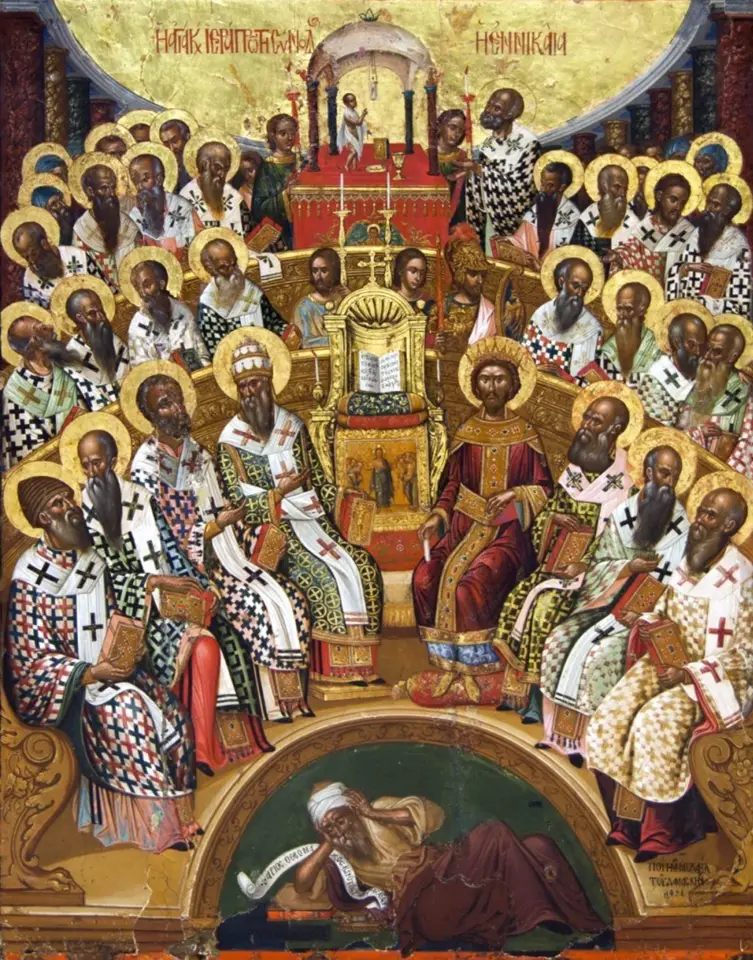
Nicaea declared the Son 'begotten, not made, of one substance with the Father' against Arius, and Constantinople in 381 extended the creed to the Holy Spirit. That creed became imperial orthodoxy. Its language of begetting is what the Qur'an later answers with 'He begets not, nor is He begotten' (Q 112:3).
People named here
- Arius
- Athanasius
- Constantine I
Links
Conflict and authority
Out
Qur'an 112 (al-Ikhlas): 'He begets not, nor is He begotten'
'He begets not, nor is He begotten' read as a counter to Nicaea's 'begotten, not made'.
opposed
scholarly hypothesisOut
Qur'an 4:171 and 5:73: 'Do not say Three' / 'God is the third of three'
'Do not say Three' answers Trinitarian formulas.
opposed
attested
Context
In
Queen Mavia's revolt and her Arab bishop Moses
Mavia demanded an orthodox (Nicene) bishop, Moses, against Arian Valens.
context
attested
Sources
- Wikipedia: First Council of Nicaea
Wikipedia contributors (CC BY-SA 4.0). Accessed 2026-11-11.
- Wikipedia: Nicene Creed
Wikipedia contributors (CC BY-SA 4.0). Accessed 2026-11-11.
- Socrates Scholasticus, Church History Book 1 (NPNF trans., PD)
New Advent. Accessed 2026-11-11.