Armenian Apostolic Church (Miaphysite branch)
Armenian Orthodox Church, Gregorian Church (outsider label)
c. 301/314 (conversion) – present; anti-Chalcedonian from 506/554
attested. The conversion date of 301 is traditional, and many historians prefer c. 314. The council decisions are attested.
Leaders
- Gregory the Illuminator
- Mesrop Mashtots (alphabet, c. 405)
- Babgen I
- Nerses II
Beliefs
Miaphysite Christology defined at the synods of Dvin. Its distinctive rites include an unmixed Eucharistic chalice and celebrating Christmas and Epiphany together on 6 January.
Home bases
Loading the map…
Vagharshapat, Armenia · 4th–present
Etchmiadzin Cathedral is traditionally founded by Gregory the Illuminator after Armenia's conversion, dated in tradition to 301 and by many historians to around 314. It is the Mother See of the Armenian Apostolic Church. The present building is largely 5th–7th century.
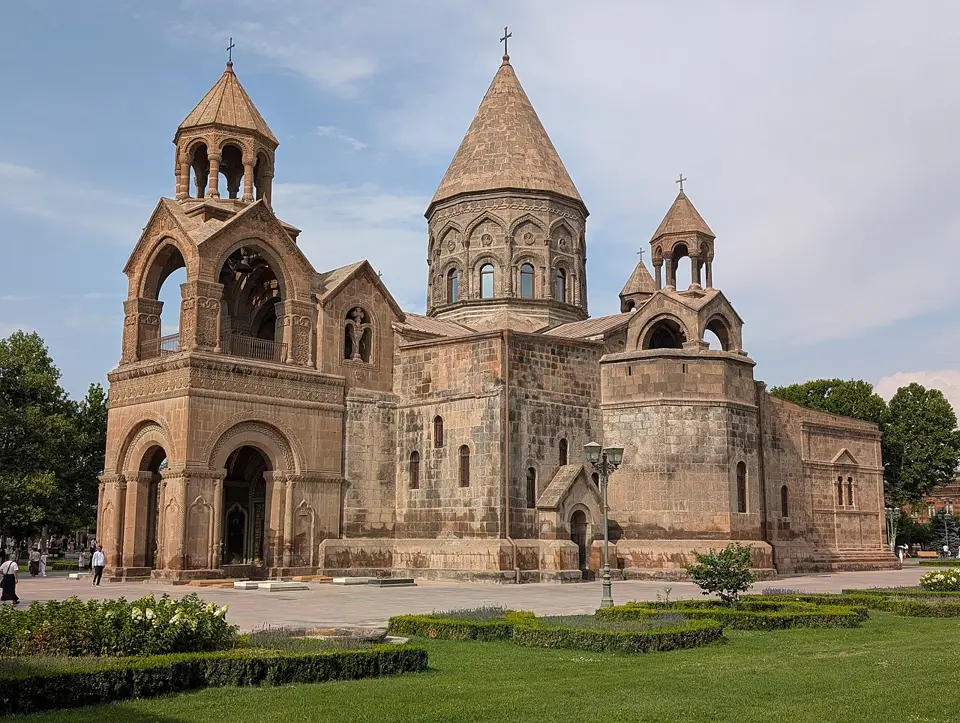
Own work. CC BY 4.0 · Wikimedia CommonsThis photograph shows the modern city, or the Wikipedia lead subject, rather than the ancient site itself. Dvin (councils of 506 and 554)
Near Hnaberd, Armenia · 5th–7th
Dvin was the Armenian capital and seat of the catholicos. Its synods of 506 (under Babgen I) and 554 (under Nerses II) rejected Chalcedon and fixed the Armenian church in the anti-Chalcedonian camp. The 554 synod is also tied to the separate Armenian calendar era.
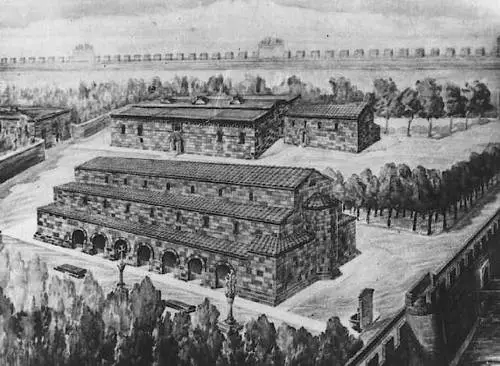
Taken from Russian wiki, source: Great Soviet Encyclopedia. Public domain · Wikimedia CommonsThis photograph shows the modern city, or the Wikipedia lead subject, rather than the ancient site itself.
Spread
Armenia and the Armenian diaspora, which spread widely after the 11th century (Cilicia, Jerusalem, Constantinople, Persia, India, the Americas).
Books
What happened to it
Survived as a national church through Persian, Byzantine, Arab, Ottoman, Persian and Russian rule and the 1915 genocide. It has two catholicosates, Etchmiadzin and Cilicia (Antelias).
Hostile sources
Byzantine Chalcedonian polemicists. e.g. letters of Photius to the Armenians 9th c.
Hostile.
Their own words
Koriwn. Life of Mashtots c. 443
Insider.
Armenian church. Book of Letters (Girk' T'ght'ots') compiled 13th c.
Insider.
Sources
- ArmeniaConfessional source
Catholic Encyclopedia 1913 (confessional). Accessed 2026-11-11.
- Armenian Apostolic Church
Wikipedia. Accessed 2026-11-11.