Muhammad ibn 'Abd Allah
c. c. 570 – 632
Place: mecca
21.422, 39.826 · On the map
His existence is attested in non-Muslim sources from the 630s (e.g., the Doctrina Jacobi, and Thomas the Presbyter, 640). Biographical details are traditional (Ibn Ishaq, c. 750). The 632 death date is challenged by Shoemaker.
Muhammad was born in Mecca, began preaching around 610 and moved to Medina in 622, where he led a growing community until his death, traditionally in 632. The Qur'an he proclaimed presents Jesus as a prophet and Messiah born of Mary, and he is the chain's end point.
People named here
- Muhammad
- Khadija
- Abu Talib
Where scholars disagree
For
- Stephen J. Shoemaker — The Death of a Prophet (2012): early non-Muslim sources suggest Muhammad was alive at the start of the conquest of Palestine (c. 634)
Against
- Islamic tradition and most historians keep 632 (e.g., Fred Donner — Muhammad and the Believers, 2010)
Links
Influence
In
Tradition says Muhammad met Zayd, who refused idol meat.
influenced
traditional
People and office
Out
al-Najashi (Ashama ibn Abjar), the Christian Negus
Tradition records letters to the Negus (surviving 'letters' are of disputed authenticity).
corresponded_with
traditionalOut
The Muqawqis of Egypt and Maria the Copt
Letter to the Muqawqis; Maria the Copt sent to Medina (traditional).
corresponded_with
traditionalOut
Tabuk expedition: pacts with Christian Ayla and Dumat al-Jandal
Treaties with the Christians of Ayla and Dumat (traditional).
led
traditionalOut
Christian delegation from Najran in Medina; the mubahala
Muhammad met the Najran Christians in Medina.
received
traditionalIn
Quss ibn Sa'ida, Christian preacher at the 'Ukaz fair
Tradition says the young Muhammad heard Quss preach at 'Ukaz.
heard_by
traditionalIn
The icon of Mary and Jesus in the Ka'ba
Al-Azraqi: Muhammad shielded the icon during the cleansing of 630.
spared_by
traditional
Sequence
In
Syriac Alexander Legend (Neṣḥānā d-Aleksandros)
A legend from about 630 versus the traditional Meccan Sura 18 (before 622) is an open chronology problem.
chronology_tension
scholarly hypothesisIn
Gulf monasteries: Siniya Island and Sir Bani Yas
Gulf monasteries were active during and after Muhammad's lifetime.
contemporary_with
attestedIn
The 'Year of the Elephant': Abraha's march on Mecca (Q 105)
Tradition dates Muhammad's birth to the Year of the Elephant.
dated_birth
traditionalIn
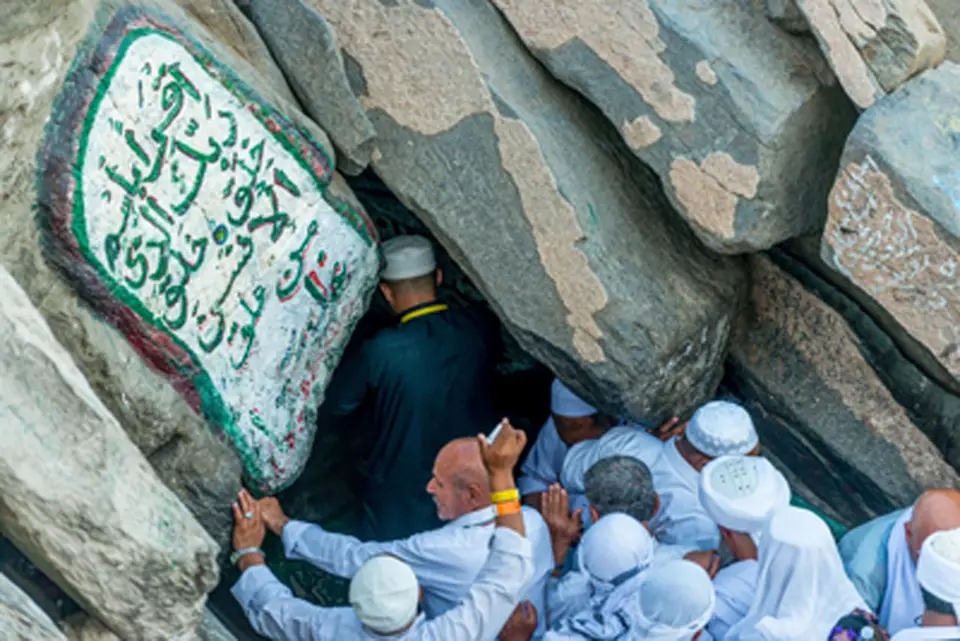
First revelation on Mount Hira
Muhammad's call at Hira (traditional c. 610).
event_of
traditional
Report and reading
In
Qur'an 61:6 ('a messenger after me named Ahmad') and the Paraclete
Ibn Ishaq identifies the Johannine Paraclete (Munahhemana) with Muhammad.
identifies
attestedIn
Qur'an 33:40: Muhammad as 'seal of the prophets'
Q 33:40 names Muhammad the seal of the prophets.
refers_to
attested
Conflict and authority
Out
The 'Believers' movement: an open monotheist community?
Donner's model of the early community as 'Believers'.
founded
scholarly hypothesisIn
Bahira the monk meets the young Muhammad at Bostra
Bahira recognizes the boy Muhammad (traditional); the later Christian legend reverses the roles.
recognized
traditional
Sources
- Wikipedia: Muhammad
Wikipedia contributors (CC BY-SA 4.0). Accessed 2026-11-11.
- Fred M. Donner, Muhammad and the Believers: At the Origins of Islam (2010)
Harvard University Press. Accessed 2026-11-11.
- Stephen J. Shoemaker, The Death of a Prophet: The End of Muhammad's Life and the Beginnings of Islam (2012)
University of Pennsylvania Press. Accessed 2026-11-11.