al-Najashi (Ashama ibn Abjar), the Christian Negus
c. c. 610 – c. 630
Place: aksum
14.134, 38.721 · On the map
That a Christian Aksumite king received Muslim refugees in the mid-610s is the agreed outline of a well-attested Islamic tradition and is widely accepted as historically plausible. The personal name, a private conversion, the funeral prayer, and any equation with Armah or Adǝrʿaz are not independently confirmed.
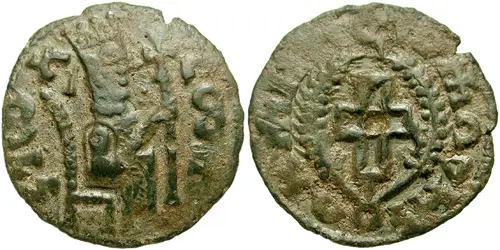
Stand-in
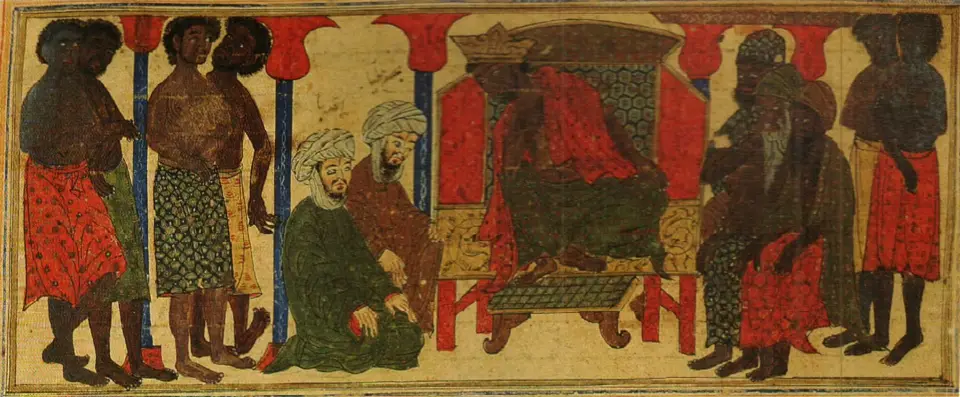
Stand-in
Al-Najashi is not a personal name. It is the Arabic form of Ge'ez nəgus, 'king,' used in Islamic sources for the Christian Aksumite ruler who, according to Ibn Ishaq and later sira and hadith, gave shelter to Muhammad's followers around 615 and refused a Quraysh demand to hand them over. Arabic tradition names that king Aṣḥama (Ashama) ibn Abjar, with spelling variants (Ashama, Asmaha, Sahama, Ella-Seham, Asbeha). Islamic accounts add that he later accepted Islam in private and that, when he died in 630, Muhammad prayed the funeral prayer for him in absentia from Medina. Ethiopian royal lists do not preserve the name Ashama. Some lists instead mention a king Adǝrʿaz / Adriaz / Aderaz as Muhammad's contemporary; one later Ethiopian notice dates that reign 603-623, though sources disagree whether that span is given in Ethiopian or Julian years. Attempts to equate Ashama with Ǝllä Ṣäḥam fail on chronology (those Saham kings fall before Kaleb in the lists). Stuart Munro-Hay suggested, as a chronological possibility only, that the Najashi might be Armah, one of the last Aksumite kings to issue coins. That remains a hypothesis. Wolfgang Hahn's numismatic work identifies Armah with Alla Amidas on the coins; it is not, on the evidence opened this turn, a demonstration that Armah was or was not the king of the hijra story. No Aksumite coin or inscription opened this turn carries the Arabic name Ashama.
People named here
- al-Najashi / Ashama ibn Abjar
- Ja'far ibn Abi Talib
- Muhammad
Links
People and office
In
First hijra: Muslim refugees at the court of the Negus
The Negus protected the emigrants.
received_by
traditionalIn
Tradition records letters to the Negus (surviving 'letters' are of disputed authenticity).
corresponded_with
traditional
Sources
- Aṣḥam b. Abǧar (Asham b. Abjar)
Stuart Munro-Hay, Encyclopaedia Aethiopica, vol. 1, pp. 369a-370a (2003), via Habesha History transcription. Accessed 2026-11-12.
- The Life of Muhammad: A Translation of Ishaq's Sirat Rasul Allah
A. Guillaume, trans., Oxford University Press (1955); Internet Archive record. Accessed 2026-11-12.
- Najashi
Wikipedia contributors (CC BY-SA 4.0). Accessed 2026-11-12.
- Armah
Wikipedia contributors (CC BY-SA 4.0), citing Munro-Hay 1991 and Hahn & West 2014 on the coins. Accessed 2026-11-12.