Church of the East (so-called "Nestorians")
East Syriac Church, Church of Persia, Jingjiao ("Luminous Religion", China), Assyrian Church of the East (modern), "Nestorians" (outsider label, considered a misnomer)
410 (Synod of Isaac) – present
attested. Extremely well attested. Whether Nestorius actually taught 'two persons' as charged is disputed, and many modern scholars think not. The 'Nestorian' label is hostile and historically inaccurate as a description of the church's origin.
Leaders
- Theodore of Mopsuestia (theological authority)
- Diodore of Tarsus
- Nestorius (d. c. 451; venerated, not founder)
- Narsai
- Barsauma of Nisibis
- Babai the Great
- Timothy I
- Aluoben (China, 635)
Beliefs
It follows the Antiochene Christology of Diodore and Theodore: Christ has two natures (kyane) and two concrete individualities (qnome) united in one person (parsopa), and it avoids language suggesting God suffered. It honours Mary as 'Mother of Christ' and generally rejected 'Mother of God'. It never accepted Ephesus (431), and the label 'Nestorian' was applied by opponents. Scholars such as Sebastian Brock call it a 'lamentable misnomer'.
Home bases
Loading the map…
Seleucia-Ctesiphon (cross-reference)
Al-Mada'in, Iraq · 3rd–8th
This is a cross-reference only. Seleucia-Ctesiphon, seat of the Catholicos of the Church of the East and of Mani's early mission at the Sasanian court, is covered in the Persia places batch.
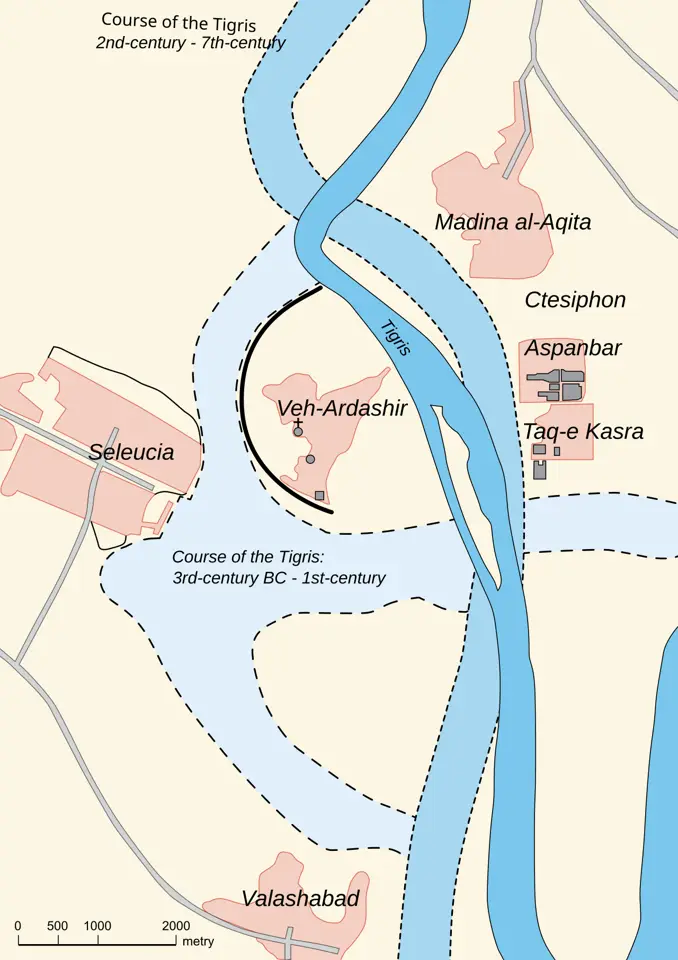
This file was derived from: Seleucia map-pt.svg:. CC BY-SA 3.0 · Wikimedia CommonsThis photograph shows the modern city, or the Wikipedia lead subject, rather than the ancient site itself. Baghdad (seat of the Catholicos from c. 780)
Baghdad, Iraq · 8th–13th
Catholicos Timothy I (780–823) moved the church's seat from Seleucia-Ctesiphon to the new Abbasid capital. There he debated Islam with Caliph al-Mahdi and directed missions to Central Asia, Tibet and China. Church of the East scholars were central to the Graeco-Syriac-Arabic translation movement in Baghdad.
Kharg Island, Iran · 7th–9th
On Kharg Island in the Persian Gulf, French archaeologists in the 1950s–60s excavated a large Church of the East monastery with a church and cells. It shows how the church followed Gulf trade routes toward India and Arabia.
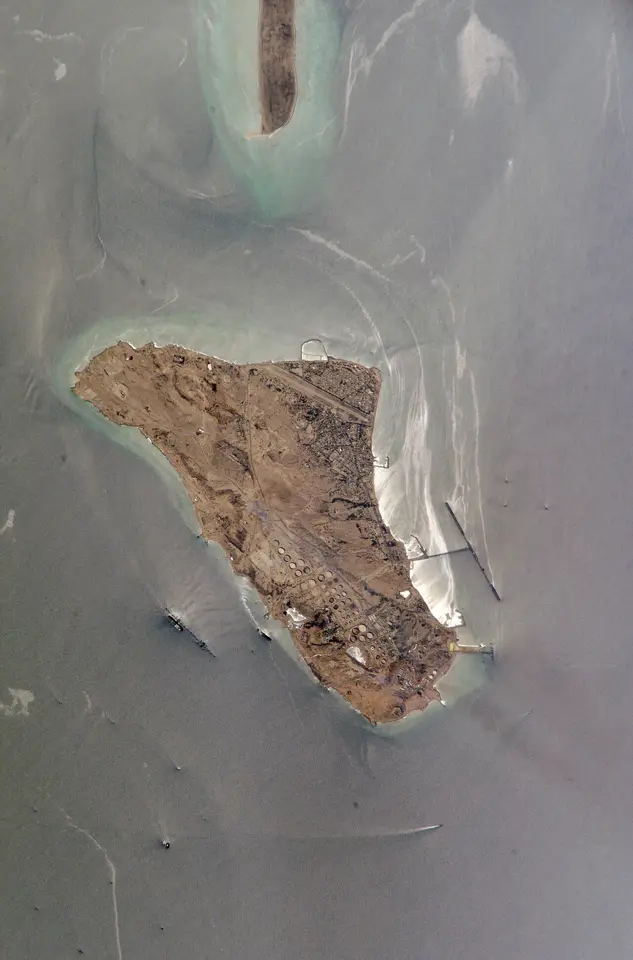
https://visibleearth.nasa.gov/images/3122/kharg-island-iran. Public domain · Wikimedia CommonsThis photograph shows the modern city, or the Wikipedia lead subject, rather than the ancient site itself. Suyab (Ak-Beshim), Chüy valley
Ak-Beshim, Kyrgyzstan · 7th–11th
Suyab was a Sogdian and Turkic town on the Silk Road. Excavations found two churches and a Christian cemetery here, with Syriac graffiti and gravestones, and the surrounding Chüy valley has many 13th–14th-century Syriac Christian tombstones. It marks the church's reach into the steppe.
Bulayiq monastery, Turfan oasis
Bulayiq, Turpan, China · 9th–11th
Bulayiq is the site of a Church of the East monastery north of Turfan. In 1905 the Prussian expedition found hundreds of Christian manuscripts here in Syriac, Sogdian, Old Uyghur and Middle Persian, including a Middle Persian Psalter. These finds show a multilingual Christian community living alongside Manichaeans and Buddhists.
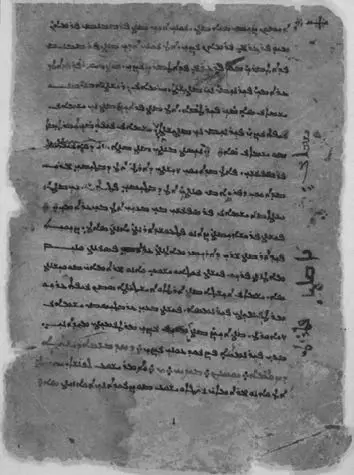
The Church of the East: A Concise History, Baum, Wilhelm; Winkler , Dietmar W.. Public domain · Wikimedia CommonsThis photograph shows the modern city, or the Wikipedia lead subject, rather than the ancient site itself. Chang'an (Xi'an): the Daqin church and the stele of 781
Xi'an, China · 7th–9th
Persian Church of the East missionaries led by Aluoben (Alopen) arrived at the Tang capital in 635. A monastery was founded there under imperial patronage in 638. The Syriac-Chinese stele erected in 781 records 'the Luminous Religion' (Jingjiao). It was rediscovered around 1625 and is now in the Beilin (Forest of Steles) Museum.
Also named in earlier place batches: Seleucia-Ctesiphon; Arbela; Gundeshapur; Merv; Nisibis (school); Edessa (School of the Persians); al-Hira; India / Thomas Christians (see Persia batch).
Spread
Organized within the Sasanian Empire (synods of 410, 424, 484/486). Its missions crossed the Gulf, Arabia and India (Malabar), and reached Central Asia (Merv, Samarkand, the Chüy valley), Tang China (635–845) and the Mongol empire (Kerait, Öngüt and Naiman converts; Rabban Sauma's journey to Europe in 1287–88). In the 13th century it probably had the widest geographic spread of any church.
Books
- Nestorius, Book (Bazaar) of Heracleides
- Narsai, Liturgical (metrical) Homilies
- Synodicon Orientale (East Syriac synodal acts 410–775)
- Babai the Great, Book of the Union
- Xi'an Stele ("Stele of the Diffusion of the Luminous Religion of Daqin in the Middle Kingdom")
- Chinese Jingjiao (Church of the East) documents from Dunhuang
- Theodore of Mopsuestia, Catechetical Homilies
What happened to it
It survived as a large church under Sasanians, caliphs and Mongols, and declined sharply after the 14th century through conversions, plague and Timur's campaigns. Its heirs today are the Assyrian Church of the East, the Ancient Church of the East (split 1968), the Chaldean Catholic Church (union with Rome from 1552/1553, consolidated 1830) and, in India, the Syro-Malabar heritage. A 1994 Common Christological Declaration with Rome recognized shared faith.
Hostile sources
Cyril of Alexandria. Letters and Twelve Anathemas against Nestorius 429–431
Hostile; included with the Ephesus documents.
Council of Ephesus. Acts and canons 431
Hostile.
John Cassian. On the Incarnation (against Nestorius) 430
Hostile.
Their own words
Nestorius. Book (Bazaar) of Heracleides c. 450
Insider apologia (Syriac).
Narsai. Metrical homilies 5th c.
Insider.
Church of the East. Synodicon Orientale (acts of synods 410–775) compiled 8th c.
Insider.
Jingjing (Adam). Xi'an Stele inscription 781
Insider.
Sources
- Nestorius and NestorianismConfessional source
Catholic Encyclopedia 1913 (confessional). Accessed 2026-11-11.
- Church of the East
e-GEDSH. Accessed 2026-11-11.
- Christianity i. In pre-Islamic Persia: literary sources
Encyclopaedia Iranica. Accessed 2026-11-11.
- Christianity iii. In Central Asia and Chinese Turkestan
Encyclopaedia Iranica. Accessed 2026-11-11.
- Church of the East
Wikipedia. Accessed 2026-11-11.